by ABFRLadmin | July 24, 2026
Imagine this.
You unlock your phone to reply to one message.
Twenty minutes later you’ve checked Instagram twice, answered an email, watched half a recipe you’ll never make, looked up a restaurant for next weekend, somehow ended up reading about deep-sea creatures… and forgotten why you picked up your phone in the first place.
Welcome to digital fatigue.
It’s a peculiar kind of exhaustion. You’re not physically tired. Yet by the end of the day, your mind feels crowded, your attention scattered, and your energy oddly depleted.
The strange part? Even our breaks happen on screens.
We rest by scrolling. We unwind by streaming. We “switch off” using the very devices that keep our brains switched on.
Let’s rethink what digital detox really means. Over the next three articles in this series, we’ll discover how making, connecting and experiencing can become powerful ways to step away from constant digital stimulation.
Beyond the Screen Series
• Series 1 | Create
Reconnecting with your hands through craft and creativity.
• Series 2 | Connect
Rediscovering meaningful conversations, shared experiences and human connection.
• Series 3 | Experience
Stepping into festivals, workshops and immersive events that invite you to be fully present.
In this first part, we begin where creativity has always lived, in our hands.
Before You Read Any Further…
Try a tiny experiment.
Take 30 seconds and touch five different textures around you.
• The weave of your shirt
• A wooden table
• A ceramic mug
• The pages of a book
• A cushion beside you
Don’t just look at them. Feel them.
Notice the temperature. The texture. The tiny imperfections.
Which one made you pause just a little longer?
Chances are that you’ll remember those textures better than the last five posts you scrolled past.
Why Craft Feels Like a Reset
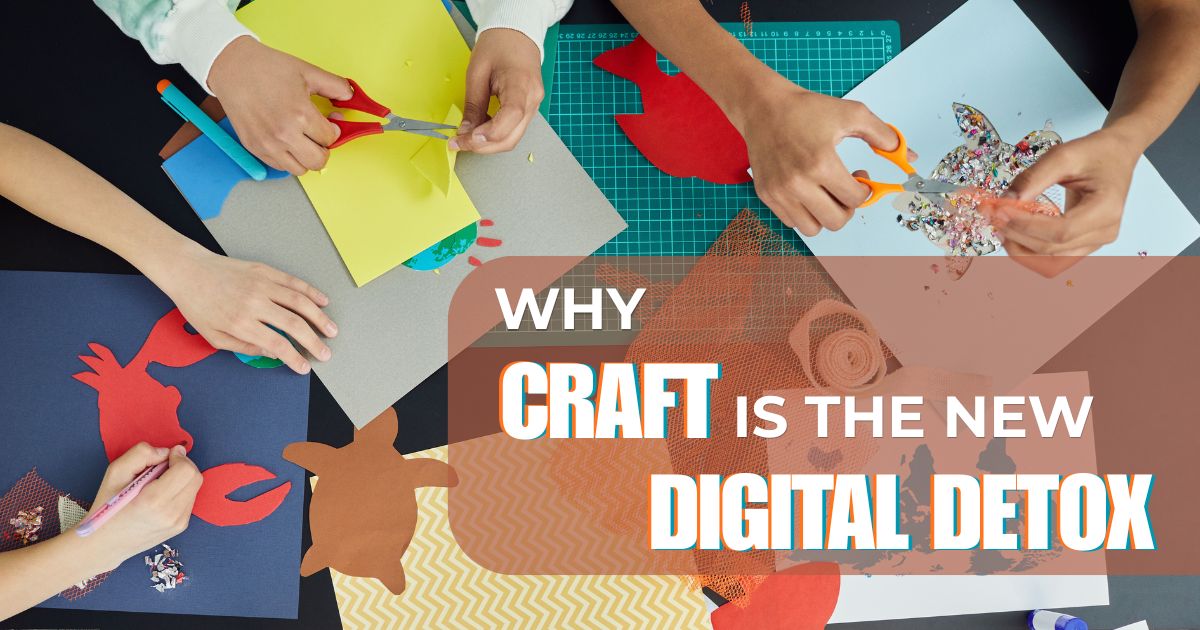
For centuries, our hands shaped clay, spun yarn, carved wood, stitched fabric, and printed textiles. Today, they spend hours tapping and scrolling across the same smooth surface.
Craft doesn’t compete for your attention. It gently redirects it.
Instead of asking your brain to process hundreds of things at once, it invites you to focus on one.
One stitch.
One brushstroke.
One block print.
One knot.
One coil of clay.
The rhythm slows your pace naturally. Your hands become busy, while your mind finally gets a chance to breathe.
Unlike our digital lives, where everything is measured by speed and perfection, handmade objects celebrate fingerprints, uneven edges and happy accidents.
Your 20-Minute Craft Detox
You don’t need to spend hours learning a new skill. Start with just twenty screen-free minutes.
Choose one activity.
Don’t worry about creating something beautiful.
The goal isn’t perfection. It’s presence.
Handmade Objects Continue the Story
The beauty of craft doesn’t end when it’s finished; it becomes part of everyday life.
A handwoven throw makes your favourite reading chair even more inviting.
A block-printed tablecloth turns an ordinary breakfast into a small ritual.
A ceramic mug somehow makes your morning tea feel slower.
These objects don’t ask for your attention. They gently change how you spend it.
Before You Pick Up Your Phone Again…
Years from now, you probably won’t remember the reel you watched on a Tuesday afternoon.
But you might remember the scarf your grandmother knitted or the mug you shaped in your pottery class. Craft leaves behind more than objects.
It leaves behind stories that can be held on to. So, put your phone down and pick up something real.
Our digital detox journey doesn’t have to be a solo one. Invite a friend, a sibling, a parent, or someone you care about to join you in these moments offline. Because sometimes, the best way to reconnect with yourself is by reconnecting with others. And that’s exactly what we’ll be exploring in our next series: the power of genuine human connection. Until then, keep creating.